

ISO 9001 : 2015

ISO 9001 : 2015
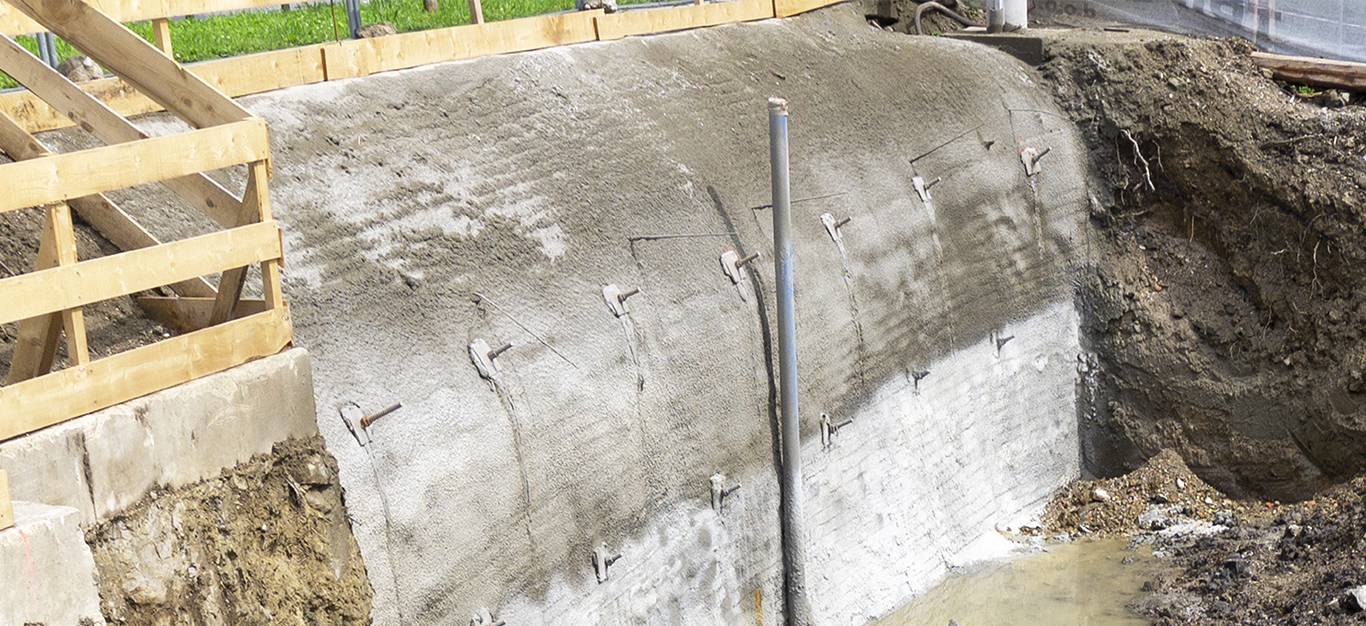
• A soil nail is passive. It is not tensioned when it is installed. It starts to carry load only when the soil moves slightly, and many closely spaced nails together turn the soil mass into a reinforced block.
• A ground anchor is active. After the grout has gained strength, the bar is tensioned and locked off. It pulls the wall or slope face back towards stable ground from day one.
| Soil nail | Ground anchor | |
|---|---|---|
| How it works | Passive: mobilises tension as the soil deforms | Active: tensioned and locked off after grouting |
| Load per element | Lower, so many nails are used | Higher, so fewer anchors are used |
| Spacing | Close, regular grid | Wider spacing |
| Bond | Grouted along its full length | A free length plus a grouted bond length beyond the slip zone |
| Facing | Usually shotcrete with plates and nuts | Usually a structural wall or beams |
| Construction | Top-down, in stages as the excavation goes deeper | Installed through the wall as it is exposed, then stressed |
| Testing | Sample pull-out tests | Each anchor is normally stressed and checked at lock-off |
| Typical use | Cut slopes, excavation support, landslide repair, widening of road cuttings | Deep excavations next to buildings, high retaining walls, structures that must not move |
Choose soil nailing when the ground can stand unsupported for a short time while each stage is excavated, some small movement of the face is acceptable, you are cutting into a slope from the top down (road and railway cut slopes, embankments, landslide control), and you want to avoid a heavy retaining wall. Soil nailing usually builds faster than an RCC retaining wall and needs less excavation. For the basics, see Soil Nails in Construction.
TerraShield Soil Nail / Solid Bar is a high-strength steel bar for this work. Tensile strength is 500–1200 MPa, diameter is 28–38 mm and length is 1.5–6 m. It is installed by drilling at the design inclination, inserting the bar, grouting, and fixing a bearing plate and nut. Hot-dip galvanising, epoxy coating or double corrosion protection can be used for permanent works.
Choose ground anchors when the wall or slope must stay almost still (for example next to existing buildings, roads or services), the loads are high and each element must carry a lot, the excavation is deep and supported by a structural wall, or the design needs the support working from the moment it is installed.
The main practical problem with both systems is the drilled hole. In loose sand and gravel, collapsing soils or broken rock, an open hole can collapse before the bar and grout go in, and casing the hole adds time and cost.
A self drilling anchor (SDA) solves this. The hollow steel bar is fitted with a sacrificial drill bit, so it is the drill rod, the bar and the grout pipe at once. It drills to depth, grout is pumped through the hollow core, and the bar stays in the ground. No casing is needed. Depending on the design, an SDA can be used as a soil nail or as an anchor.
TerraShield Self Drilling Anchor is available from 25 mm to 76 mm, in R (rope) and T (trapezoidal) thread profiles. A splicing system allows longer lengths, and epoxy coating is available for permanent work. Typical uses include slope stabilisation, tunnelling, mining and railway and metro work. Read more in Why Self-Drilling Anchors Are Essential.
1. Will the drilled hole stay open? If not, use a self drilling anchor.
2. Can the face move slightly? If yes, soil nails are usually the economical choice.
3. Must the wall stay still, or are loads high? Use ground anchors.
4. Is it a slope cut from the top down? Soil nails, with shotcrete facing and drainage.
The final choice always comes from the geotechnical design. It depends on soil and rock properties, groundwater, loads, and what lies behind the wall.
1. What is the main difference between a soil nail and a ground anchor?
A soil nail is passive and carries load only when the soil moves. A ground anchor is tensioned after grouting, so it supports the structure straight away.
2. Is a soil nail the same as a rock bolt?
No. Soil nails are used in soil or weak rock and rely on the bond between grout and soil. Rock bolts are used in competent rock.
3. Can a self drilling anchor be used as a soil nail?
Yes. An SDA can be designed as a soil nail or as an anchor. It is especially useful where a drilled hole would collapse.
4. Are soil nails permanent?
They can be designed for temporary or permanent works. Permanent nails need corrosion protection such as galvanising, epoxy coating or double corrosion protection.
Share your slope or excavation height, soil report (if available), design loads and site location. TerraShield will help with soil nail bars, self drilling anchors and the related accessories.
Ask about Soil Nails → · Ask about Self Drilling Anchors → · WhatsApp +91 84200 12365 · info@terrashieldindia.com
Share your requirement and our team will get back with price & specifications.