

ISO 9001 : 2015

ISO 9001 : 2015
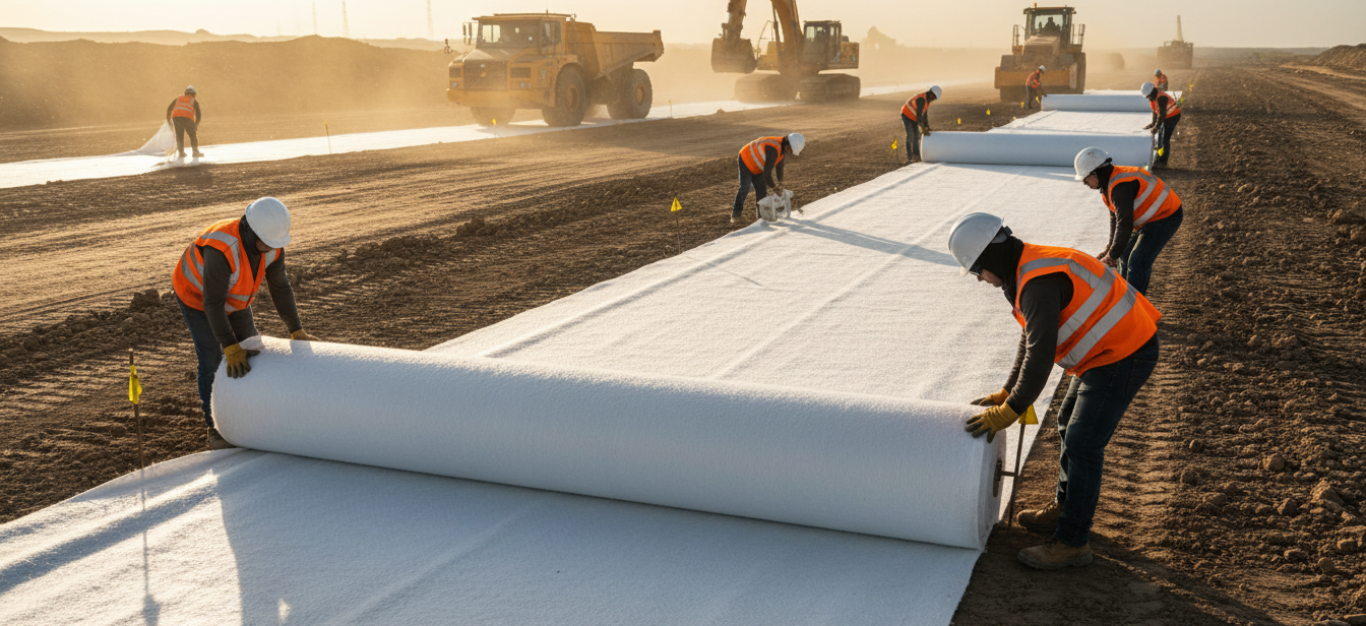
TerraShield non-woven geotextile is made from staple fibres that are mechanically bonded by needle punching into a dimensionally stable fabric. It is available in polypropylene and polyester grades. In the ground it does four jobs: separation (it stops subgrade soil and aggregate from mixing), filtration (water passes through while fine soil is held back), drainage and protection.
GSM means grams per square metre: the mass per unit area of the fabric, tested to ASTM D-5261. A 200 GSM geotextile weighs 200 g per square metre. TerraShield non-woven geotextile is available from 120 GSM to 600 GSM.
| Property | 120 GSM | 150 GSM | 200 GSM | 250 GSM | 300 GSM | 400 GSM | 500 GSM | 600 GSM |
|---|---|---|---|---|---|---|---|---|
| Thickness (mm) | 1.1 | 1.3 | 1.6 | 1.8 | 1.9 | 2.5 | 2.9 | 3.4 |
| Grab tensile strength (N) | 480 | 540 | 720 | 865 | 1010 | 1325 | 1570 | 1980 |
| Trapezoidal tear (N) | 210 | 230 | 300 | 360 | 415 | 510 | 600 | 705 |
| Puncture strength (N) | 290 | 315 | 400 | 525 | 650 | 785 | 910 | 1080 |
| Mullen burst (kPa) | 1550 | 1655 | 2175 | 2630 | 3185 | 4050 | 4700 | 5500 |
| Permittivity (s-1) | 2.5 | 2.4 | 2.0 | 1.6 | 1.2 | 0.8 | 0.7 | 0.6 |
| AOS (µm) | 180 | 180 | 150 | 150 | 120 | 106 | 90 | <70 |
All grades: elongation at break 60%, UV resistance 70% (ASTM D-4355, 500 hours), roll width up to 6 m. Source: the polyester specification table on our non-woven geotextile page, which also lists the polypropylene grades.
• Stronger and thicker: puncture strength rises from 290 N at 120 GSM to 1,080 N at 600 GSM, and grab strength from 480 N to 1,980 N. Heavier grades survive sharp aggregate and heavy construction traffic better.
• Slower water flow: permittivity falls from 2.5 to 0.6 s-1, so water passes through a heavy grade more slowly than through a light one.
• Smaller openings: the apparent opening size (AOS) falls from 180 µm to under 70 µm, so finer soil particles are retained.
So a higher GSM is not automatically better. The right grade balances strength against water flow and soil retention for the job.
These ranges are general guidance. The final grade should always follow the project design or specification.
• Highways: 150–300 GSM for subgrade separation.
• Railways: 250–350 GSM for formation protection.
• Hill roads: 300–600 GSM where high drainage and puncture resistance are needed.
Geotextile is often used together with reinforcement products. For weak subgrades, see our comparison of geocell vs geogrid.
• Maintains the designed aggregate thickness
• Prevents loss of fines into the subgrade
• Improves the modulus of the composite section
• Reduces maintenance cycles
Non-woven geotextile is chemically inert and resists biological degradation. In buried conditions it is designed for a service life of 50+ years.
1. Which GSM non-woven geotextile is used for road work?
For highway subgrade separation, 150–300 GSM is typical. Hill roads with high drainage and puncture demands use 300–600 GSM. Always check the project specification.
2. Is a higher GSM geotextile always better?
No. Higher GSM gives more strength and puncture resistance, but lower permittivity and a smaller opening size. Choose the grade that matches the job.
3. What is the roll width of non-woven geotextile?
Roll width is up to 6 m for the grades in the table above.
4. Is non-woven geotextile UV resistant?
The grades in the table retain 70% strength after 500 hours of UV exposure (ASTM D-4355). Geotextile should still be covered soon after laying.
Share the application, soil type, area and site location, and our team will suggest a GSM and send a quote.
Ask about Non-Woven Geotextile → · WhatsApp +91 84200 12365 · info@terrashieldindia.com
Share your requirement and our team will get back with price & specifications.