

ISO 9001 : 2015

ISO 9001 : 2015
• A geogrid is a flat, two-dimensional grid. It is laid under or within the aggregate layer. Stones lock into its apertures, and the grid spreads the load sideways through tension in its ribs.
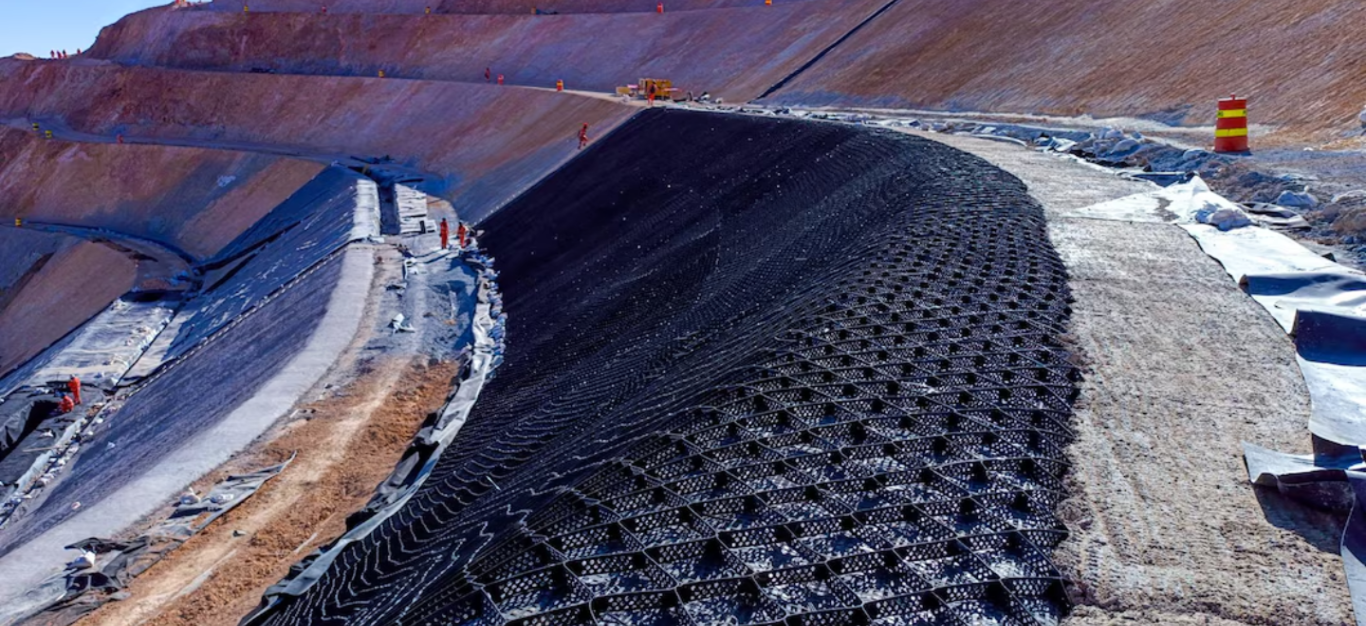
• A geocell is a three-dimensional honeycomb. HDPE strips are welded into cells that are expanded on site and filled with soil, aggregate, sand or concrete. Each cell confines its infill on all sides, which turns loose fill into a stiff mattress.
| Geocell | PP biaxial geogrid | |
|---|---|---|
| Form | 3D honeycomb of welded HDPE strips | Flat 2D polypropylene grid |
| How it works | Cellular confinement: restricts lateral movement of the infill | Interlock: aggregate locks into the apertures and the ribs carry tension |
| Sizes (TerraShield) | Cell heights from 75 mm to 250 mm (100, 150, 200 and 250 mm common), strip thickness to suit the load | SS20, SS30, SS40 (20, 30, 40 kN/m), SS2, SSLA20 and SSLA30; rolls 3.8 or 4.0 m wide |
| Infill | Local soil, granular fill, sand, crushed aggregate or concrete | Compacted aggregate above the grid |
| Typical use | Very weak or soft subgrade, slopes, channels, canal lining, erosion control, load support | Road and railway base reinforcement, embankments, working platforms |
| Slopes and erosion | Excellent, and can be vegetated | Mainly for reinforcement, not surface erosion |
| Installation | Expand panels, anchor, fill and compact | Roll out, overlap and cover with aggregate |
Geocell is usually chosen when the subgrade is very weak, such as black cotton soil, loose sand or soft clay, or when the job also needs erosion control. The confined infill acts as a semi-rigid slab, which increases bearing capacity, reduces settlement and spreads vertical loads over a wider area.
Geocell also works on slopes and in channels, where a geogrid cannot hold the surface. It can be filled with soil and vegetated for green slopes, or filled with concrete for a rigid lining. Because it can use locally available infill, it can reduce the quarry material a project needs.
TerraShield Geocell is made from UV-stabilised HDPE and has a design life of 50+ years when installed as per guidelines. Applications include subgrade stabilisation, slope and hill protection, MSE and RE walls, railway track-bed stabilisation, canal slopes and lining, reservoirs and landfills.
A geogrid is usually the economical choice for road and railway base reinforcement over a reasonable subgrade, where the aim is to reduce rutting and the thickness of the granular layer. It is quick to install over large areas: roll it out, overlap adjacent rolls and place the aggregate.
TerraShield PP Geogrid comes in SS20, SS30 and SS40 biaxial grades (20, 30 and 40 kN/m ultimate tensile strength), plus SS2 and the large-aperture SSLA20 and SSLA30. For grade-by-grade data and roll sizes, see PP Geogrid Grades, Roll Sizes and Specifications.
Yes. On some designs, a geogrid is placed at the base to separate and reinforce the subgrade, and a geocell layer above it confines the base course. Whether this is needed depends on the subgrade strength and traffic load, so it should come from the design.
1. Is the subgrade very soft or loose? Consider geocell.
2. Is it standard base reinforcement on a reasonable subgrade? Geogrid is usually the economical option.
3. Does the job include a slope, channel or erosion control? Use geocell.
4. Do you want to use local soil as infill? Geocell allows it.
The final choice comes from the geotechnical design: subgrade strength, traffic load, fill material and drainage.
1. What is the main difference between geocell and geogrid?
A geogrid is a flat grid that reinforces aggregate by interlock. A geocell is a 3D honeycomb that confines its infill on all sides.
2. Which is better for black cotton soil?
Geocell is often preferred on very weak subgrades such as black cotton soil, because cellular confinement increases bearing capacity and reduces settlement. The final choice depends on the design.
3. Can geocell be used for slope protection?
Yes. Geocell is widely used for steep slope stabilisation, soil erosion control, green slopes and canal or riverbank slopes.
4. What cell heights are available for geocell?
TerraShield Geocell is available in cell heights from 75 mm to 250 mm, commonly 100, 150, 200 and 250 mm, with strip thickness selected for the load.
Share your subgrade type, traffic or load, area and site location, and our team will help you choose between geocell and geogrid and quote quantities.
Ask about Geocell → · Ask about PP Geogrid → · WhatsApp +91 84200 12365 · info@terrashieldindia.com
Share your requirement and our team will get back with price & specifications.