

ISO 9001 : 2015

ISO 9001 : 2015
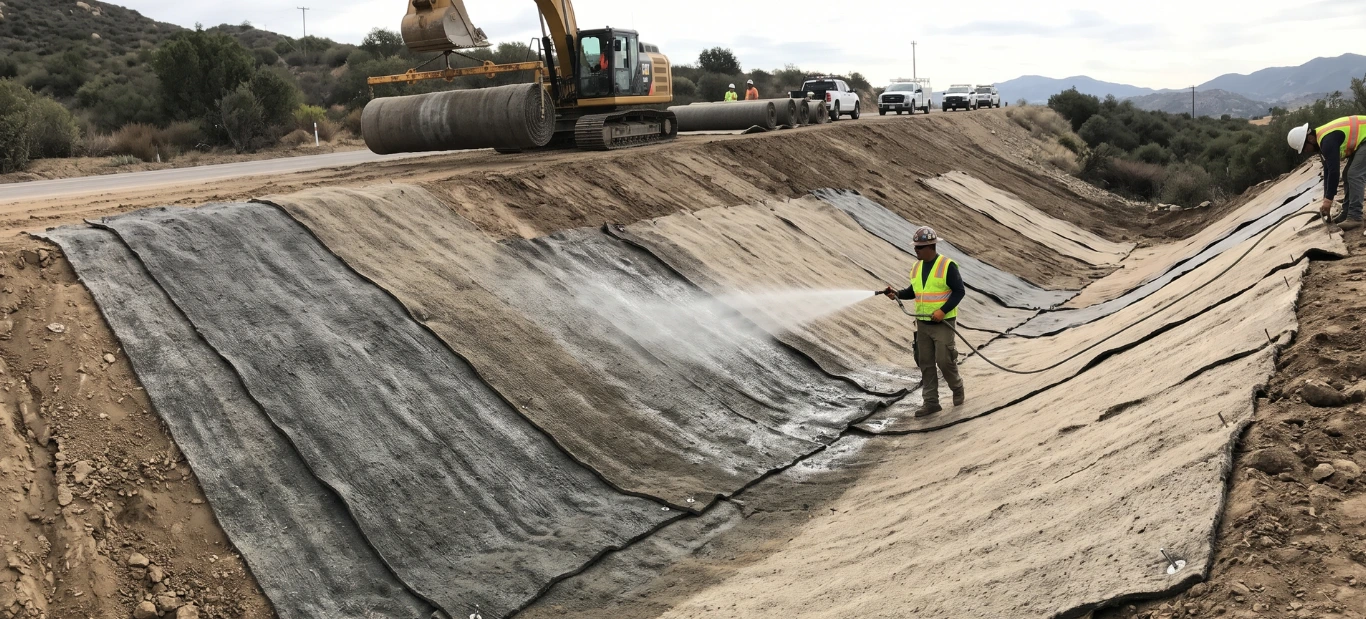
Think of it as concrete delivered in a roll. You unroll it, fix it in place, and add water. The ground gives it shape. The water makes it set. In this guide, we explain how it works, the main uses of cement blankets, and how it compares with ordinary concrete.
A typical GCCM has four parts that work together:
The cement stays inside the fabric until you add water. That keeps the roll stable in storage and ready to use on site.
Water starts the hardening. Once the blanket is laid and wet, the cement cures inside the fabric. Setting begins in about 1 to 2 hours. Full strength is usually reached in 24 to 48 hours, depending on temperature, humidity, and water supply. The result is a concrete layer that fits the surface below.
This works even in flowing or standing water. So a cement blanket can be installed underwater, which is helpful for canal repairs and emergency works.
The main cement blanket uses are surface protection jobs where speed and durability both matter. Common applications include:
Because the blanket comes in rolls, it also suits remote or hard-to-reach sites.
Bare soil washes away when water flows over it. A cement blanket covers that soil with a hard, uniform layer. Rain and runoff slide over the surface instead of cutting into it. This makes a cement blanket for erosion control a good fit for channels, spillways, riverbanks, and mining areas, where water moves fast and repairs are costly.
On slopes, loose soil can slip, wash out, or crack. A cement blanket seals the surface and holds it together. Because it is flexible, it settles into curves and uneven ground. Many teams use a cement blanket for slope protection on highways, railway embankments, and cut slopes. For deep-seated movement, it is usually paired with reinforcement such as soil nails.
Together, these benefits mean lower project cost and less time on site.
Installation is simple. Most projects follow these steps:
There are two common ways to hydrate:
Always follow the manufacturer’s installation guide for overlaps, fixings, and water quantity.
Both create a hard protective lining. The difference is how you get there.
| Feature | Cement blanket (GCCM) | Conventional concrete lining |
|---|---|---|
| Installation speed | Up to 10x quicker | Slower, with casting and curing time |
| Formwork | Not needed | Needed |
| Mixing | None, supplied as a dry roll | On-site or ready-mix |
| Labour and machinery | Low | Higher |
| Flexibility | Follows uneven ground | Rigid |
| Underwater installation | Possible | Difficult |
| Thickness | Thin and uniform | Usually thicker |
| Design life | 50+ years | Varies with design and conditions |
| Carbon footprint | Lower | Higher |
In short, choose a cement blanket when speed, access, and flexibility matter. Choose conventional concrete when the design needs a thick structural section.
A cement blanket is a good choice when you need:
Keep in mind that it protects the surface. It doesn’t replace structural reinforcement. Good surface preparation and proper hydration are also essential for the best results.
Planning a project? See Cement Blanket Price in India: What Decides the Cost for the factors that set the price and what to send for an accurate quote.
1. How long does a cement blanket last?
A properly installed cement blanket can last over 50 years, depending on exposure and site conditions.
2. Can you install a cement blanket underwater?
Yes. It can be installed in flowing or standing water. Hydration happens naturally.
3. Is a cement blanket waterproof?
Once cured, it forms a low-permeability layer. With an impermeable backing, it resists water infiltration well.
4. How thick is a cement blanket?
It comes in several thicknesses, roughly 5 mm to 12 mm, depending on erosion severity, water flow, and structural needs.
5. How long does it take for a Cement Blanket to set and harden?
A cement blanket once rolled out and cured, starts setting in 1 to 2 hours. Full strength typically arrives in 24 to 48 hours.
Share your requirement and our team will get back with price & specifications.